Author: Anthony Irtelli

  • Spotlight on Youth Ambassadors

    Spotlight on Youth Ambassadors

    What is a Youth Ambassador? We hand over to Jordan and Ed from YMCA Right Here and Emma and Jess from YMCA WiSE to tell you more.

    Ed, YMCA Right Here Youth Ambassador

    What is a YMCA Right Here Youth Ambassador?

    A YMCA Right Here Youth Ambassador is a young person aged 16-25 who is involved in planning and delivering everything we do at Right Here including campaigns, school and community engagement, research projects, social media etc. We attend weekly volunteer meetings where we share our views in a group and discuss various projects and ideas. We decide which area we want to get involved in and work alongside other like-minded volunteers through every stage of the project, from planning to delivery.

    What difference has volunteering with YMCA DLG made to you?

    Volunteering with YMCA DLG has made an immense difference in increasing my confidence when approaching new environments. For example, I was given the opportunity to lead a focus group and plan a campaign around gender identity that will be delivered in the next few months.

    I have also been involved with Youth Wise, a meeting for young people, youth workers, councillors and council officers to discuss and contribute to decisions about youth services in Brighton and Hove. Being involved in such a diversity of projects allows me to engage in learning about, and assist, my local community. It allows me to make a real difference in the life of young people in a way which is very unique to the diverse opportunities volunteering with YMCA DLG provides.

    What have been the highlights of your role so far?

    There are two which stand out to me. Firstly, I presented to Brighton and Hove City Council on matters brought up in one of the Youth Wise meetings. Another major highlight was attending and delivering one of the Right Here workshops about Youth involvement and participation at the YMCA 175 celebration at the ExCel in London. In addition to being given an opportunity for public speaking at the YMCA global summit to celebrate 175 years of good work and empowerment, it was incredible to see how many young people and lives the YMCA impacts every day, as well as hear and learn the work and ethos of different YMCAs around the world.

    What is a YMCA WiSE Youth Ambassador?

    The YMCA WiSE project is all about educating young people on all aspects around healthy relationships. During lockdown we’ve been meeting every week in order to create content around these subjects in ways we feel are relevant to our age groups. A lot of the topics we cover are things we didn’t necessarily get to learn about in our school sex education lessons, so we are all passionate about making resources that better equip others with information we wish we had had access to.

    We recently released a work booklet for local schools and project workers to use with young people that focused on staying safe and happy in online relationships. Every week we make new social media content, some of our most recent posts include information around different sexual and gender identities, how to spot toxic behaviours and how to set personal boundaries and look after your mental wellbeing.

    What difference has volunteering with YMCA DLG made to you?

    Volunteering with the YMCA WiSE project is great. The group is incredibly welcoming, and everyone has different skills and backgrounds which means that we have interesting discussions on important topics that ordinarily aren’t spoken about. I’ve learnt a lot from the other volunteers and it’s wonderful to have a space where I feel confident in sharing new ideas.

    I’m currently finishing my master’s degree in gender studies so a lot of the issues we cover I have some theoretical background in. However, volunteering with YMCA WiSE has enabled me to consider how to make this information relevant and accessible to others in a practical way, particularly through the social media content we create.

    What have been the highlights of your role so far?

    The biggest highlight so far was when we finished our first resource around online safety and got such a positive response from those who used it. It was at the beginning of lockdown and we had to suddenly create online resources which we hadn’t done before.

    We worked together really well, and It was cool to work on something from start to finish and see it implemented and used by others. We are also lucky enough to have project workers do sessions with us around different topics that we feel we’d like to know more about. They are always interesting and give us great ideas to make our content more relevant and useful.

    If you’re interested in becoming a YMCA WiSE Youth Ambassador, please email [email protected] or [email protected]
  • Lockdown lessons from a YMCA DLG resident

    Lockdown lessons from a YMCA DLG resident

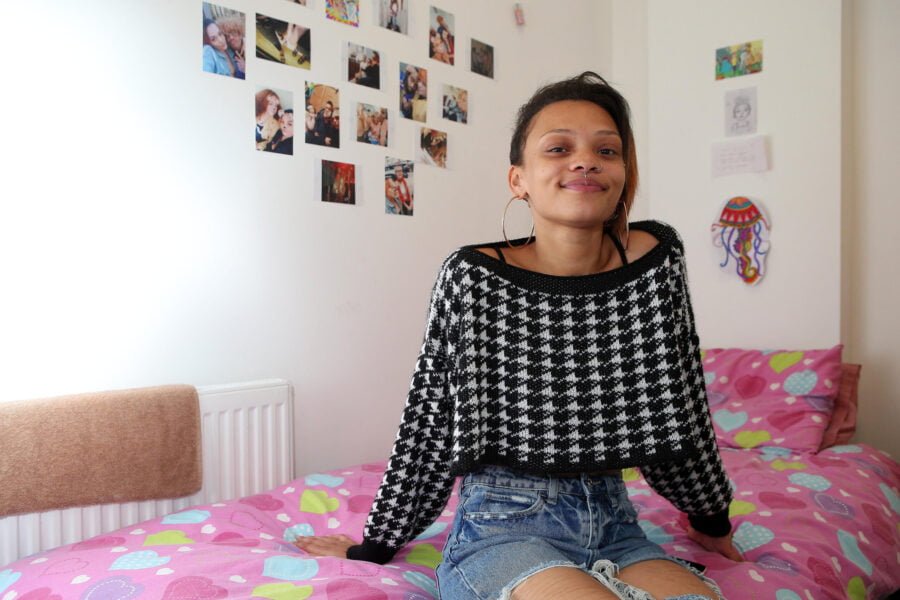
    A young person, Susie*, shares her experience as a YMCA DLG resident during lockdown and her hopes for the future.

    What brought you to YMCA DownsLink Group?

    My family was split up due to an incident that then had a detrimental impact on my mother’s mental health. My mother and I found out that my little sister had been assaulted while under our care. From this, everything spiralled.

    In the months after the incident, police, social workers and courts had gotten involved. My mum had no-one with her and was alone in a courtroom full of people and solicitors telling her she wasn’t good enough to look after her child. She became extremely depressed and had to rely on sleeping medication to just get enough sleep.

    It was decided that my little sister would be sent to live in a foster home. That was the final nail in the coffin for my mother. We went abroad to see family, for what I thought was a holiday, and I returned by myself in September to start school again. She told me she would return in October. October turned to December, and then January came and she stated that she didn’t want to come to the UK because all she would think about is how she is no longer with her child.

    I felt for her, but it still hurt being without her. While I was back home and studying, I had no way of paying rent (I was relying on benefits). I could just about manage food but my situation was not going to get any better. The landlord would pop over to collect money but I didn’t have a job and the adult renting the house was not in the country.

    One day a social worker from another district, who had helped us in the past, visited and helped me out. She took me to my local council and spoke on my behalf about the situation I was going through. She worked tirelessly to get me some help and make sure I had food.

    Finally, there was a light at the end of the tunnel – the council managed to get me into YMCA DLG supported accommodation. I was super thankful for social workers for helping me so much and I moved into my accommodation with less stress on my shoulders.

    What difference has living with us made to you?

    During the first couple of months living in supported accommodation, I got my first ever permanent job working in retail. I had this job for almost two years until they shut down their stores due to Covid-19.

    I had sessions with someone to talk about how I was feeling and to just let out all my emotions. I felt alone for a while in my accommodation but it was only because I missed my family. So the barrier I had to conquer was to allow myself to accept the situation that my little sister and my mother were in and try and live the best life for myself so I can stop feeling so down.

    It took time but I got there in the end. It took a year of living in my accommodation to be acclimated with being content and happy being by myself and to know that if I ever needed help or assistance, I could go right to reception and they’ll do the best they can to help me in any way.

    How has the lockdown and Covid-19 affected you?

    I’m an introvert and I love staying indoors, so lockdown hasn’t been much different to what I usually do. It hasn’t affected my mental health but it has affected my physical health as I haven’t been getting enough exercise as I am always in bed.

    What have been the challenges during lockdown?

    So far I’ve been living blissfully and enjoying my time here in supported accommodation.

    Have there been any positives from the experience? 

    I have learnt a lot about myself. I learnt that I was quite a clean person (a trait I got from my mum) and I have actually been more talkative with people, as I was quite shy in the beginning.

    What difference have YMCA DLG staff made to you, during this time?

    They have helped me tremendously – with food banks, rent management, social group clubs and one-to-one sessions to talk to a professional about my mental state. They have been there for everything I needed.

    We all take for granted having constant support until it’s no longer there. It’s a blessing to have someone always look out for you and it makes life that much easier every day.

    What are you most looking forward to doing after lockdown?

    Seeing my friends, my little sister, my boyfriend and going on holidays again.

    How do you think life will be different post-Covid-19? 

    I believe that it won’t change much. Historically, after viruses spread among the population and were then treated, nothing really changed and it just went back to normal.

    In my ideal world, I would love for there to be a control of pollution so that global warming wouldn’t increase. It’s definitely noticeable at this point that the world is heating up, and we have to make a change fast.

    * The name and photo have been changed to protect the identity of the young person

  • Back to school with e-wellbeing

    Back to school with e-wellbeing

    Going back to school after the summer break can be an anxious time for children and young people. However, this September, most young people will have been off school for around six months due to lockdown, so the transition back into the classroom is likely to be far more difficult.

    e-wellbeing enables young people to explore their mental health needs online and signposts them to services if they need acute support. The platform recently launched a ‘Back to School’ page, aimed at teachers, pupils or parents/carers, filled with practical resources, videos, and downloadable assets in order to support everyone through this difficult transition period.

    We caught up with Dr. Celia Lesquerre, Consultant Clinical Psychologist and Head of Clinical Development, to find out about the impact of lockdown on young people’s mental health. We also asked Nicola Harvey, e-wellbeing’s Digital Wellbeing Development Lead, for practical ideas to support mental health and wellbeing.

    Lockdown and Mental Health

    Dr. Celia says: “Lockdown will have impacted all children and families, but the impact will vary sometimes considerably from one child or family to another. Even within a family, you may notice that children can respond differently. We are now learning that at least a third of children and young people are reporting an increase in difficulties, particularly regarding their mental health and wellbeing.  In a YouGov poll, and research carried out by Barnardo’s, they have found that children are feeling lonelier (41%), more worried (38%), sadder (37%) and more stressed (34%).

    The lack of social contact with friends and wider family can be difficult for people to manage, in addition to not being able to do “normal things”. In fact, for children and young people, more than two-thirds have said that not seeing their friends has been one of the most difficult things about the lockdown. All these things could have a knock-on effect on schoolwork, behavioural issues, and family life.

    Having said this, for some, lockdown has had positive impacts on family dynamics and wellbeing. For many parents, the chance to spend more time at home, with their children, the ability to work from home, less commuting, and a sense of a slower pace of life, in general, has led to a reassessment of work and career priorities. Some studies have also highlighted that spending more time together as a family can be beneficial for many children and young people.”

    Back to School after Lockdown

    Dr. Celia goes on to say…

    “Schools are likely to introduce a number of different safety measures in order to reduce the possible spread of Covid-19. This could mean:

    • being in smaller groups (possibly not with their closest friends)
    • having staggered start and finish times to the school day, or breaks
    • being instructed to wash hands more frequently
    • having to remain socially distanced from one another
    • some may be wearing masks

    The details are still emerging and may well be different from one school to another. These differences may leave young people feeling more anxious and some may already have developed some fears about catching the virus and what that might mean for them.”

    Supportive Strategies

    Nicola Harvey commented: “As we transition out of lockdown, the e-wellbeing platform continues to help young people explore their mental health needs at this vital time. We are delighted to be broadening our remit to enable teachers, pupils, and parents/carers to support young people’s mental health all year round.”

    Here are some practical ideas from Nicola to support young people, teachers, and parents impacted by the transition back to school:

    Children and Young People

    • Take part in the quiz on the e-wellbeing homepage for tips and advice
    • Keep a journal to document the ‘highs’ and reflect on the ‘lows’
    • Practice deep breathing to find a sense of calm
    • Schedule some ‘worry time’ by finding a safe space to talk about feelings with a trusted adult
    • Take part in physical activities to help refocus the mind and get the heart pumping
    • Reduce screen time and get some more fresh air
    • Prepare for the return to school e.g. buy school supplies, travel to/from the school

    Parents

    • Explore the e-wellbeing platform
    • Connect with other parents, possibly on social media to exchange ideas
    • Look on the school’s website and plan trips to school (even if closed)
    • Talk openly about lockdown with your child and how this makes them feel
    • Arrange socially distanced playdates with friends
    • Read Covid-19 safety information with your child (contact the school or local authority if in doubt)

    Teachers

    • Look after your own wellbeing e.g. practice mindfulness, spend time with family/friends
    • Contact the Education Support Partnership for wellbeing support
    • Use the resources on the e-wellbeing schools’ page
    • Keep up to date with school policies regarding CV19
    • Follow government guidelines

    If you are still concerned about a young person transitioning back to school, it’s important to talk to someone early on, so click here to find mental health support in your area.

    For more information on e-wellbeing and to access the free resources visit https://e-wellbeing.co.uk/schools.

  • Sam’s mammoth 100-mile cycle challenge

    Sam’s mammoth 100-mile cycle challenge

    The pandemic has meant many mass participation sport events have had to be postponed or cancelled, meaning a loss of much needed income for many charities.

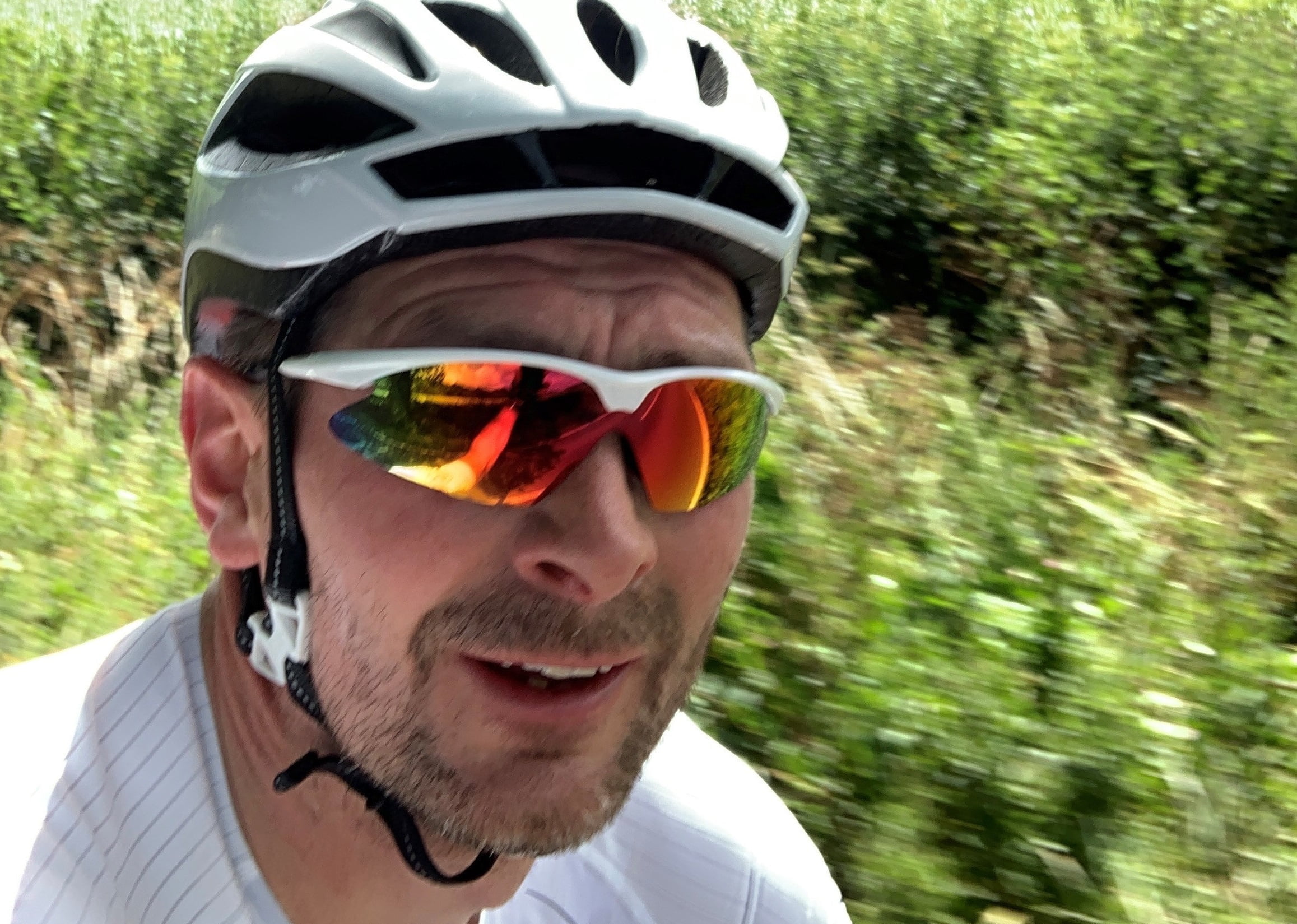
    While Prudential RideLondon 2020 is one of those events to be cancelled, that hasn’t deterred our wonderful supporter Sam, who will be taking on a mammoth challenge and cycling 100 miles virtually on Sunday 16 August to support our work.

    In his own words:

    ”I had several challenges set for 2020 including London to Brighton bike ride (Which I completed in my own way in the end) as well as the Castle to Coast Triathlon, but all are cancelled or delayed until next year as is the Prudential RideLondon 100 mile challenge. However I WILL complete the PRL course, indoors on Zwift with all the hills and much, much more sweat!! This will be my longest and most challenging day in the saddle to date; the awesome Prudential Ride London – Surrey 100. That’s 100 miles of Surrey’s most challenging terrain with Climbs up Leith Hill and Box Hill….. I CAN FEEL MY QUADS SCREAMING ALREADY!”

    With just two weeks to go, we’re wishing Sam the best of luck!

    Show your support and find out more about his challenge here.

  • YMCA Right Here turns 10!

    YMCA Right Here turns 10!

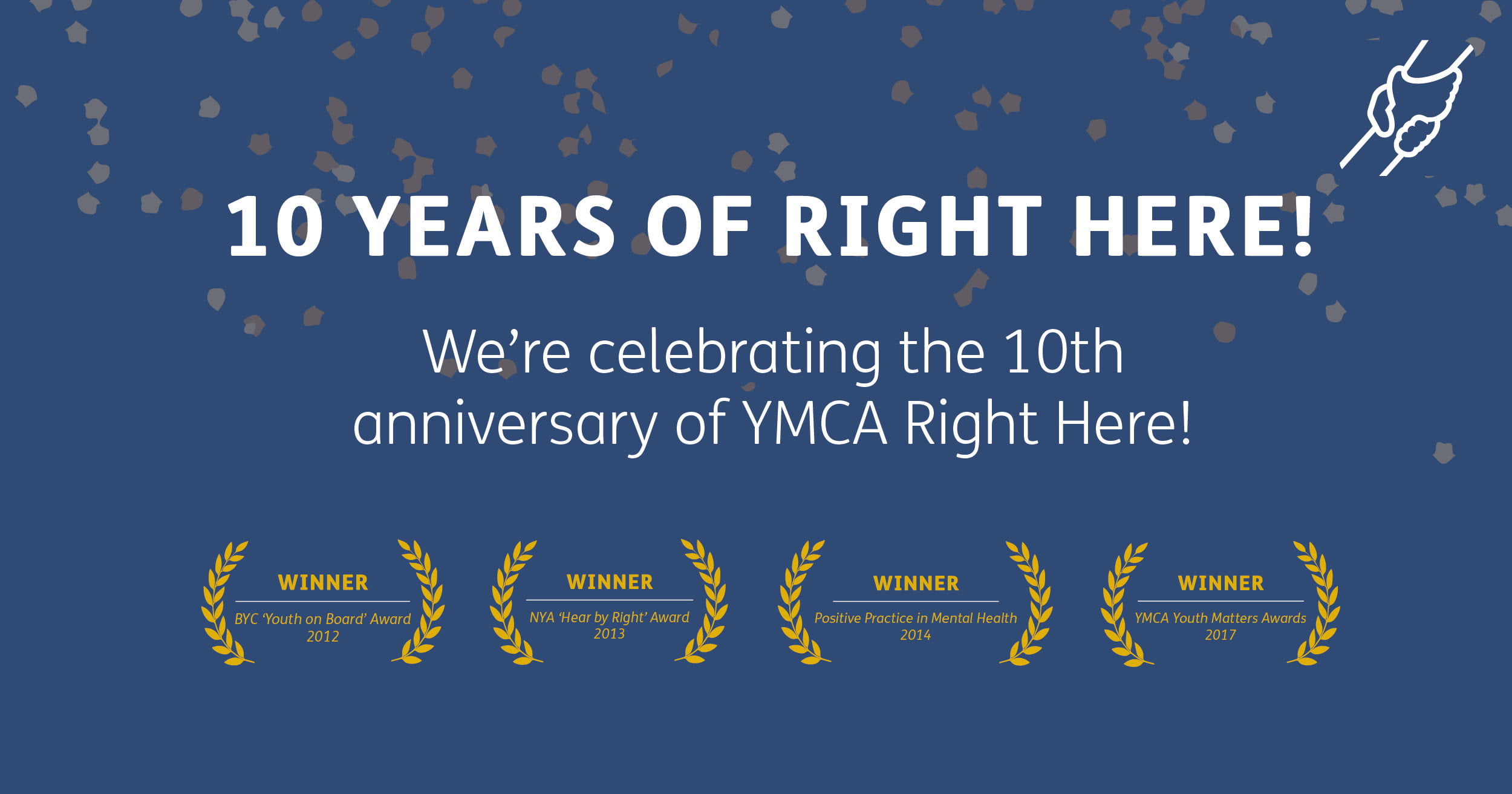
    The award-winning youth involvement & influencing project, YMCA Right Here, delivered by YMCA DownsLink Group, was officially launched 10 years ago this week. Over the last decade Right Here has been responsible for delivering some of the most innovative youth-led health promotion initiatives and campaigns, including #IAMWHOLE – a campaign to reduce stigma and normalise conversations around mental health.

    #IAMWHOLE was originally developed as a local Brighton & Hove campaign, in partnership with the NHS and fronted by Jordan Stephens from the Rizzle Kicks. However, through involving the YMCA federation across England & Wales, we launched #IAMWHOLE as a national YMCA and NHS campaign on World Mental Health Day 2016. What no one could have predicted was that within 24 hours we would reach over 121 million people across the world and deliver the YMCAs first global campaign, some achievement for YMCA DownsLink Group and for Right Here!

    One memory that’s stayed in my mind was a young man, who two days later saw and recognised a campaign banner hanging outside our Youth Advice Centre in Brighton, which gave him the confidence to walk through our doors and finally ask for help with his mental health.

    ‘I‘ve been thinking about how brokenness is part of being made whole. That the lowest of lows become the greatest opportunities for healing when properly supported #IAMWHOLE’
    (a young person’s post on social media)

    Youth volunteers have been at the heart of Right Here since its inception in 2010, as one of four pilot projects through the Right Here national initiative developed and funded by the Paul Hamlyn Foundation… and so began the journey we continue on today of youth Involvement and Influencing, with Right Here young volunteers co-planning, designing, and delivering a range of health promotion work.

    One of their earliest projects was to research young peoples’ experiences of visiting their GP, particularly in relation to their mental health. At the time 50% of young people interviewed said they would not speak to their GP about their mental health, an alarming statistic.

    ‘It was great to see that our research had hit a nerve and people my age were willing to share personal experiences and suggest improvements; from one focus group alone it was clear that the clinical services provided in Brighton and Hove for Young People was a talking topic and that young people want there to be change and actively involved in bringing about this change’
    (Right Here youth volunteer)

    This inspired the youth volunteers on a journey of GP engagement work (which continues today), to influence GPs to improve their responses and interactions with young people; culminating in them speaking at a national conference for the Royal College of General Practitioners, and devising and delivering training to GP Registrars as a formal element of their assessed training programme through the Kent, Surrey & Sussex Deanery – which was truly ground-breaking.

    ‘Invaluable – really useful for our exams and actual daily practice’

    ‘Much more confident in approaching young people and especially talking about substance misuse/mental health/attitudes. Thank you!’
    (feedback from 2 of the GP registrars trained by Right Here youth volunteers)

    The project has been blessed with talented and creative staff and project managers, all with a passion for empowering, developing and nurturing young peoples’ involvement and leadership in the project; and for promoting health and wellbeing amongst children and young people.

    I have lost count of the number of amazing Right Here youth volunteers who’ve been involved over the past ten years, but it literally is in the hundreds. The common thread that runs between them is that Right Here has provided a safe environment to develop self-belief, skills, and confidence; to provide them a platform to have a voice; to better understand their own mental health challenges; to form unlikely and lasting friendships; and to find a place where they have a strong sense of ownership, of belonging, of value, and in their words ‘a YMCA  family’.

    ‘Right Here has given me a sense of belonging. It feels amazing to be a part of something I’m so proud of’

    ‘Our meetings are a safe place where I don’t feel judged. I can share my experiences with other members who have gone through similar things’
    (Right Here youth volunteers)

    To celebrate our 10 year anniversary, we will be hearing from some of the Right Here volunteers over the course of the week, from the past and present, and showcasing some more of their incredible achievements through our communications channels. Our specially designed timeline also captures some of our monumental milestones over the years.

    Not only have we inspired so many young people, but they have inspired us as a charity and helped us realise and value the importance of youth voice, and welcoming and supporting any and all young people to be able to influence the YMCA (our operations, our strategy, our vision) and to effect change in their lives, their communities and the world around them.

    I’m excited for the next ten years as we develop further our ambitions around Youth Involvement & Influencing within YMCA DownsLink Group, ensuring children and young people’s voices are central to everything we do.

    Mark Cull – Head of Youth Involvement


  • (Re)introducing Sleep Easy 2020!

    (Re)introducing Sleep Easy 2020!

    What is Sleep Easy?

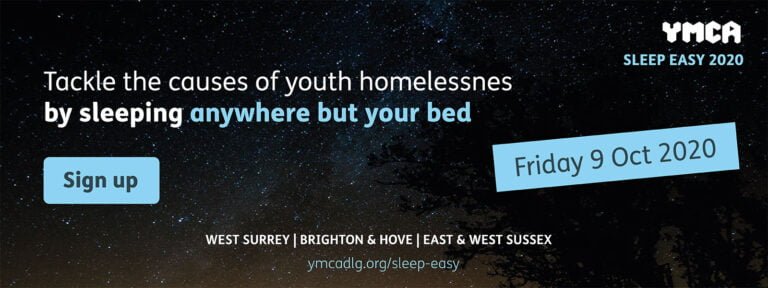
    Sleep Easy is a challenge event asking you to spend one night sleeping somewhere other than your bed, all to raise vital funds to help us tackle the root causes of youth homelessness.

    Due to the coronavirus, we had to postpone our original mass participation event due to go ahead in March – so we have given it a stylish makeover to ensure it’s an accessible, inclusive and safe event. As such, this October we are asking you to grab a sleeping bag and sleep somewhere other than your bed – a garden, hallway, lounge or other safe space. Children of all ages are welcome – with special activity packs just for them!

    There will be an online agenda that you can connect with on-the-night through any internet enabled device– hearing from our young people, staff and wider community.

    When and where is it taking place?

    Sleep Easy is taking place on Friday 9 October 2020, 7pm onwards – from your garden, lounge or any other safe space!

    Last year Sleep Easy participants raised an average of £200 each and we are challenging each of our 2020 participants to set a fundraising target at the same level!

    How can I get involved?


    Click here to register!

    Sleep Easy, and the funds it raises, has never been more important and urgent – thank you for your support.