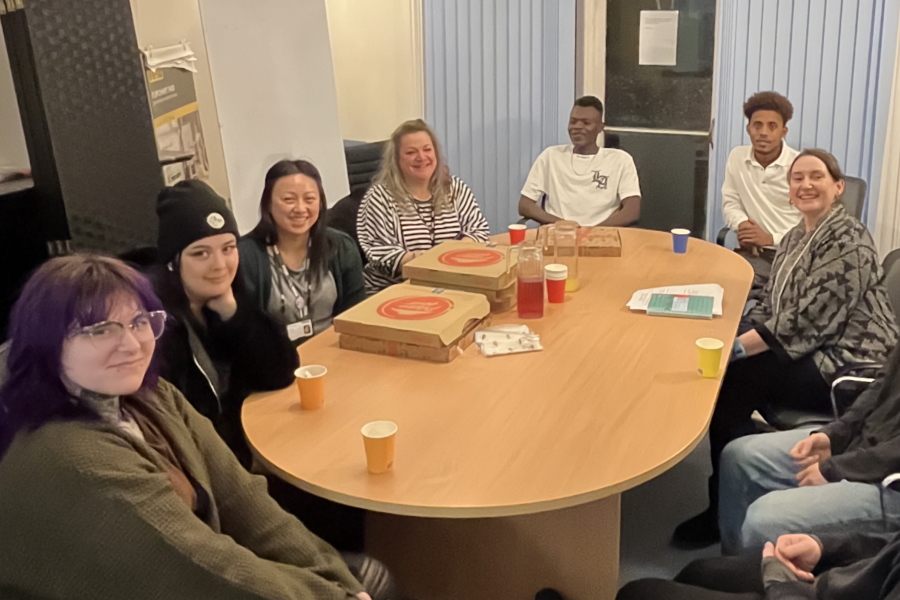
We recently held our fifth Youth Council meeting since starting the group in April last year. Residents travelled from Guildford, Brighton and Worthing to continue discussing how to improve their experiences across our supported housing projects.
We’re really pleased to have created a solid, committed core group of young people in the Youth Council who are bonding with one another and growing in confidence to speak out each session and represent their fellow residents.
The session began with the Youth Council Reps sharing a short video of each of their houses that they had created themselves and then narrated. They shared the videos so they could see what each project looked like, understand each other’s experiences better and spark conversations about what works well and what could be improved in each home.
One of the Reps asked the Guildford residents if their project “felt like home”. They immediately answered yes, sharing that they love living there, it is very homely and everyone feels like family. This answer seemed to inspire some of the group who later discussed how they could make their houses feel more ‘home-like’, such as improving their common spaces and organising more group activities for residents to do together.
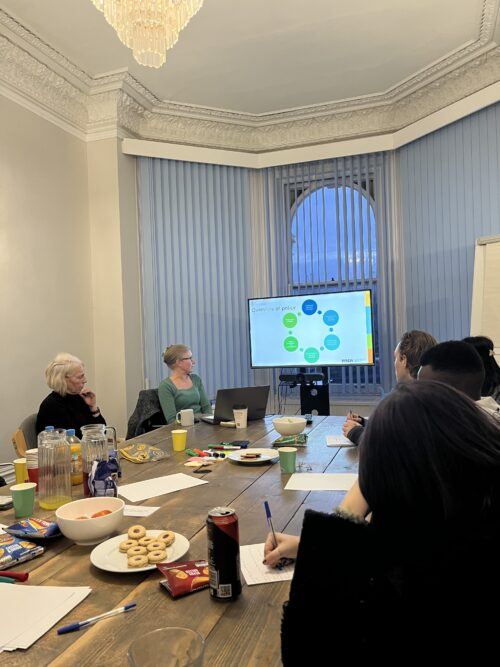
The overall focus of the session was on our new rent policy. This was an area of interest for the Youth Council and had been brought up during resident meetings across the projects. We were pleased to be joined by members of our finance team who presented a breakdown of the new rent policy and addressed questions pre-planned from the Reps. The young people really engaged with the presentation, taking notes and asking questions as they went. One young person was so intrigued by the approval process that they asked if it was possible to join the Board or become more involved with the trustees.
The group also watched a short film made by Adi, an ex-resident, made for refugee children and their families (read Adi’s story here). Jessica, our Guildford Inspire Coach, shared the video with the group and will invite Adi to the next Youth Council meeting to speak as an inspiring guest.
The Reps said that they’d like to have more speakers come in to the meetings, such as Trustees or ex-residents who can talk about their experiences at YMCA. They also came up with a plan to help recruit more Youth Council members so that all of the projects are represented.
At the end of the session, the Reps were asked to summarise the meeting in a few words. Everyone said they’d learnt a lot and were looking forward to going back to their houses and relaying all the latest information. A few examples of their feedback are:
“It’s been wonderful to meet everyone.”
“I’m definitely going to follow up on the things we’ve talked about.”
“I’m really excited to be here today.”
The Youth Council have been invited to join part of the next YMCA DownsLink Board meeting at their away day in March. We’re looking forward to seeing what this opportunity brings for these young people.
Brighton & Hove City Council (BHCC) has confirmed that it will not recommission the specialist housing youth advice and tenancy support contract delivered by Brighton’s Youth Advice Centre (YAC). The Youth Advice Centre, run by YMCA DownsLink Group, has been preventing youth homelessness by providing housing advice and a pathway into emergency accommodation for young people in the city for 30 years. Currently, it is the front door for any young person facing homelessness as well as providing, or signposting, many other vital support and advice services.
YMCA DownsLink Group are deeply concerned about the impact the loss of the service will have on young people facing homelessness across the city. In the last six months the number of young people accessing the service, in housing crisis, has increased by an average of 32% compared to the same period last year.
Emily Brock, CEO of YMCA DownsLink Group said:
We’re devastated by the decision to cut funding for the housing support contract at the Youth Advice Centre. Our primary concern is the impact this will have on already vulnerable young people in the city. We’re deeply worried that without this service more young people will be forced to sleep rough.
Our Youth Advice Centre provides a specialist, trauma informed, safeguarding response to homeless young people. The decision to cut this funding removes this vital pathway for young people, so that 18-25s will have to present at the council’s customer care centre alongside adults. We’re concerned that the council will not be able to deliver the standard of care needed to manage young people’s complex situations. We believe that it’s a false economy as it will undoubtably cost the public purse more if young people are left in crisis, need emergency housing, and then potentially end up on an inappropriate and avoidable adult pathway.
She continues:
Whilst we understand the financial pressure that BHCC is under, we believe this is a vital service and this decision will impact the ecosystem of support for young people in the city. Our priority is to work with our staff, BHCC and our sector partners to best support the young people already accessing the service and to manage the transition into whatever alternative provision is devised by the council. Without doubt, our preference would be to work with our colleagues at BHCC to offer a reduced service, in line with budget constraints, and continue to support children and young people in our city with this vital, and effective, provision.
Every year, the Youth Advice Centre supports around 1,000 children and young people and plays a key role in early intervention, advocacy and signposting to prevent crisis. It is the only provision for 13-25 year olds in Brighton & Hove that is open daily Monday to Friday, has no service threshold criteria and does not operate waiting lists for support. Annually, it achieves a 73% homeless prevention rate through specialist housing advice and family mediation to prevent parental eviction. It is also the referral pathway into ‘homeless that night’ host accommodation provided by local charity, Night Stop, which offers an alternative to sleeping rough.
As well as Night Stop, organisations such as Brighton Housing Trust, Amaze, Just Life, The Clock Tower Sanctuary, Trust for Developing Communities, Citizens Advice and Grassroots Suicide Prevention are concerned that the loss of this service will negatively impact young people and have a knock-on effect on their own services.
By working in a holistic way, the Youth Advice Centre provide a preventative service. For many, homelessness is preceded by other issues in their lives. Having the housing advice available within the Youth Advice Centre means that those who do not immediately meet thresholds are offered a range of support, signposting and referrals which build their resilience and can prevent future escalation. It is highly unlikely that this wrap around support could ever be replicated by the council, so the opportunity for preventative work would be lost.
The Youth Advice Centre also plays an important advocacy role between social care and housing support and organises joint assessments for 16/ 17-year-old children. It supports young people into private rented accommodation and problem solves tenant disputes to prevent youth eviction and reduce homelessness. It attends the city’s ‘Supported Accommodation Panel’ and is often the only agency who has ongoing oversight and care of young people waiting for supported accommodation. The staff at the Youth Advice Centre manage high levels of complexity and risk, largely around safeguarding, whilst young people wait for specialist services.
Brighton’s Youth Advice Centre is an important gateway into many other services in the city. It is a model of good practice offering easy access for young people and supports the council’s own Mental and Emotional Wellbeing Plan. It works in partnership with schools, GPs, Police, adult & children’s social care, adult & children’s mental health services, third sector youth providers, street outreach services, supported accommodation providers, Department for Work and Pensions, colleges and universities, drug & alcohol services and sexual health services.
At a time when youth homelessness is growing there are concerns, across the city, about the impact on young people if this core preventative youth service is lost.
YMCA launch national manifesto campaign to put issues affecting young people at heart of next election
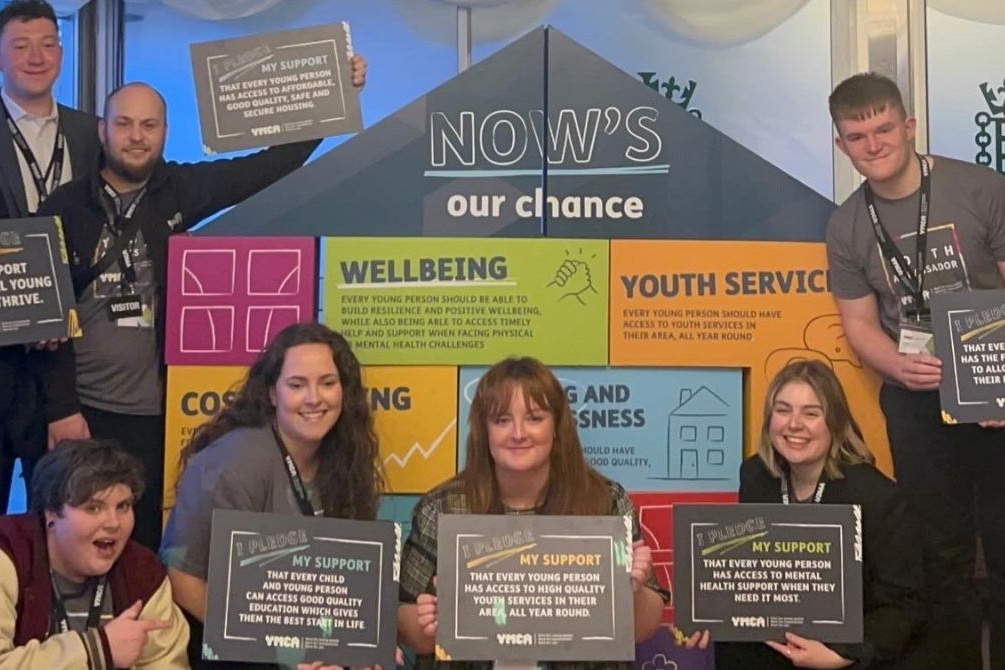
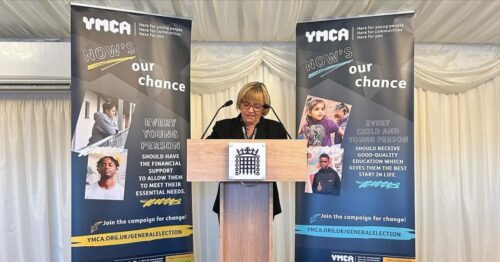
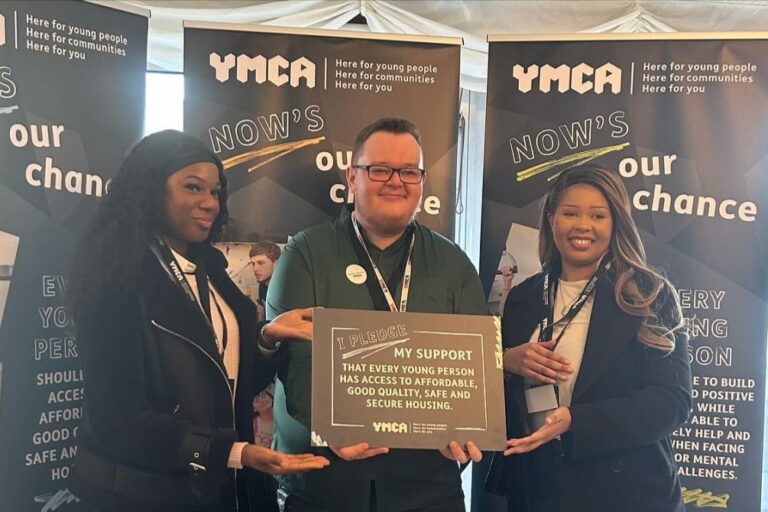
As the UK prepares for the next General Election, our national body, YMCA England and Wales, has launched a manifesto to urge political parties to seize the opportunity to create positive change for young people. As an organisation on the frontline of delivering youth services, we are only too aware of the increasing challenges faced by young people. We’re supporting the “Now’s Our Chance,” manifesto which emphasises the need for targeted policies aimed at addressing the issues they face.
What is in the YMCA Manifesto?
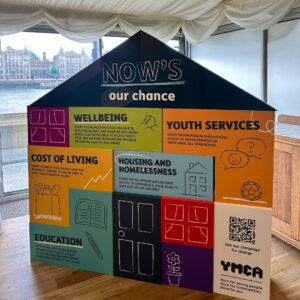
The ongoing adverse impact of the pandemic, coupled with the cost-of-living crisis, housing shortage and historic underfunding, has left lasting scars on communities across the UK. YMCA England and Wales has worked alongside young people to provide the next government with key recommendations including addressing homelessness, providing preventative youth services, tackling cost of living crisis and improving access to mental health support.
The vision of the YMCA Manifesto
“Our vision of the future for young people and communities is one where everyone has stability, security, and access to the resources they need to thrive,” says Denise Hatton, Chief Executive, YMCA England & Wales. “We want everyone across the country to be able to flourish, not just survive, and to be treated with fairness, equity, and dignity.”
What is the issue with the housing crisis
The housing crisis, marked by a severe shortage of affordable homes and rising private rents, impacts young people disproportionately due to lower wages and benefit caps. It is one of the biggest single issues facing young people. This is particularly acute in our region (Sussex and Surrey) where housing costs soar above the national average. The manifesto calls for urgent action to create policies that address the housing shortage and alleviate hardship and youth homelessness.
#PlanForThe136 and our commitment to this campaign
To strengthen the call for government action on youth homelessness, we are also backing the #PlanForThe136k campaign. Led by New Horizon Youth Centre, the #PlanForThe136k campaign is a collective of over 120 charities (including YMCA England and Wales and many local YMCAs) fighting to end youth homelessness.
As we’ve previously reported, 136,000 young people approached their council as homeless last year. However, we know the true scale is a lot higher (read more here). In the last six months, our Brighton Youth Advice Centre, which is currently the front door for any young person in housing crisis, has seen an increase of 32% in presentations. This isn’t an issue that can be solved at a local level. As a collective we believe that there needs to be a government plan in place to respond to this escalating crisis.
Your support is needed to help these young people facing homelessness
As a simple way to support the campaign and drive this issue onto the government’s agenda, you can sign this petition. Achieving ten thousand signatures will trigger a debate in parliament and bring the issue of youth homelessness to wider attention.
Cuts to Youth Services and the impact for young people
Speaking about the complex issues impacting young people, our CEO, Emily Brock said:
“Over the past ten years services supporting young people have been decimated. This, coupled with the rise in housing costs, low wages and job insecurity, is negatively impacting this current generation and will have consequences for children growing up now.
As the CEO of a local YMCA I back the national manifesto and, in particular, I believe that tackling youth homelessness must be a priority, for this, or any subsequent government. It’s an issue that can only be effectively addressed at a national level. I hope that the YMCA manifesto will put the increasingly complex issues young people face, at the heart of public debate during this election year.”
Another crucial element of the manifesto addresses the cuts to youth services. Over the past decade there’s been a staggering 73% decline in funding (£1.1bn) which has led to the closure of many youth centres, advice services and specialist support services The manifesto calls for a comprehensive strategy that addresses these cuts and promotes and sustains youth work. Our region has suffered from these cuts and we’re also part of the wider campaign, led by Young Minds, Fund the Hubs, which is calling for a national approach to securing walk-in, one-stop-shop mental health hubs for young people. Our experience and impact data shows that early prevention work is the key to achieving better long-term outcomes for young people and prevents crisis (see our previous article on value of youth work).
The impact of the cost of living
The cost-of-living crisis has also compounded the challenges faced by young people, who struggle with essentials due to lower wages and benefits. The manifesto calls for a benefits system that safeguards essential needs and is calling for these specific changes to current government policy:
The Government should introduce an Essentials Guarantee for benefits, an independently calculated figure which would determine the minimum level of benefits to meet people’s essential needs.
Young people under 25 who are living independently should receive an additional Universal Credit payment, to bring their standard allowance up to match the over 25s rate.
Residents of supported accommodation should receive a Universal Credit work allowance to allow them to earn more before their income from benefits is tapered.
The final point in this policy is particularly relevant to the 650 young people who are given a home in our supported accommodation each year. Part of our holistic approach is to ensure that they get the wraparound care and support they need to be able to ‘move on’ into independence. This means helping them back into education, training or work. However, the current benefits situation penalises those who are ready to work by reducing their allowance. Then, even if they are ready to move on, it is very difficult to find affordable accommodation in the private rental sector. We want to see government policies consider the different kind of support young people, without family to fall back on, need to thrive and live independently.
The mental health crisis among young people
The mental health crisis among young people has intensified during the pandemic, exacerbated by long NHS waiting lists. The YMCA manifesto stresses the need for accessible mental health services and a preventive approach, urging leaders to prioritise and enhance mental health support. Again, this is an issue that impacts the young people in our region every day. We are the largest provider of counselling and wellbeing services in Sussex and Surrey, and despite attempts to increase capacity, lack of funding and complex commissioning structures, mean that waiting lists continue to grow and our services are stretched. We want to see access to mental health for all children and young people made a priority in the next government.
If you want to get more involved and help us put pressure on all political parties to put issues affecting young people into the heart of the debate ahead of the election please……
I would describe myself as having a Christian faith. This can mean so many different things and take so many different forms – so, what do I mean by that?! It will be interesting to try and write it down. It seems to me as though it is not a static thing – it is emerging and changing all the time for me…
My sense is that we are all more than cognitive, physical and emotional beings; we also exist within a spiritual domain as well. And I believe that in this spiritual domain there is a fundamental source of goodness and love in the world which is ever present, and which it is possible for us to be in connection with. An energy which is fundamentally non-judgmental and accepting of everyone. I call this energy, this spirit, God. I believe that the person of Jesus was a particularly powerful and special example for us of what it looks like to live a life in connection with God.
Being a Christian is about seeking to live a life of faith, believing that I am loved and I am accepted for who I am – not just the good and worthy bits of me – but the whole of me. It is not about following a system of belief or a set of rules and dogmas. It is about a life lived in connection with God.
What does this look like in my life? In my inner world, it is about seeking to be honest with myself about my lightness and my shadow, where I am imperfect and need help, being real about who I am and how I am and opening myself up to the possibility of change, learning and growth in my spirit and my life. In my outer world it is about trying to choose a way of living which is kind, accepting of others, seeking to have a positive impact on the world I inhabit, even in a tiny way. It is attempting to live with values of love, generosity, forgiveness and hope.
I do pray, most often when I am out and about walking the dog or travelling. I find it hard to sit quietly and pray and I don’t particularly enjoy formal prayers in a church setting. It is more of an ongoing conversation that I have with myself and with God – and I pick it up whenever and wherever I am.
I think there are two main things I find when I pray. The biggest thing that prayer does is to help adjust my perspective on things. It often helps me to stand back, reflect carefully and see things differently.
The more time I spend talking with and being in the presence of God who I understand as the essence of all goodness, love and kindness in the world, the more I feel it rubs off on me and how I try and make sense of my experiences or the experiences of others in the world. And because of this I find praying a very precious resource. It helps me ’right-size’ myself and my opinions and put them into a bigger context.
The second thing it does is help me to learn how not to hold on to things too tightly and try and fix and control them myself. I bring to God in prayer things that I worry about, people I am concerned about, world horrors that feel overwhelming – and I ask them to take these things and look after them for me. It is an act of letting go which I also find important as there are so many things I care about but can’t control in the world.
Living a life of faith for me is about finding a deeper sense of identity. Not that I always feel clear on that, by no means. A lot of the time it simply feels like a mystery…and daily life is tough…and that is OK. I don’t feel I need to have all the answers and label things as ‘the truth’; for me it is enough to believe that we are all loved and accepted for who we are and that we can live with an
experience of this – I call that grace.
Youth homelessness is growing. The latest government figures show that the number of young people approaching their council for help has grown year on year.
Homelessness in England and Wales is a growing and increasingly pressing issue. The latest figures released by government present a comprehensive overview of the state of statutory homelessness and emphasise the challenges young people face. Last year, 23 298,430 people in the UK approached their council seeking help with homelessness (an increase of 6.8% from 2021/22).
Whilst this number is shocking, it’s likely to be an underrepresentation of the true figure as it doesn’t take into account the hidden homeless (such as those who are sofa surfing – more information about sofa surfing).
1 in 5of all individuals assessed as homeless or at risk of homelessness across England and Wales were aged 16-24. That’s 165 young people every day who are assessed as homeless, or at risk of it,in England and Wales.
We are only too aware of the issue. In the last six months we have seen an average increase of around 32% in the number of young people approaching our Brighton Youth Advice Centre in housing crisis. Despite being able to prevent homelessness for the majority of those that come to us, through securing emergency accommodation, referring them into other charities such as Sussex Nightstop, helping arrange alternative accommodation with friends or relatives, or getting them into family mediation, increasingly there are times when they run out of options.
One YMCA Youth Advice Centre Housing Support Worker explained:
“We can’t always solve their problems or give them the answers that they want, which is really difficult. Sometimes we just haven’t got the answers, or the resources, and there isn’t any appropriate housing available. We will exhaust every option to try and find them appropriate housing, but sometimes we have to do the worst thing and tell a young person that their only option is rough sleeping.
But, even in that situation they know that we will make sure the street team know where they are. We always want to make sure that that young person leaves this space feeling like they’ve been heard and acknowledged and that we are going to work on their case and keep them on our books until we find them a housing option.”
The lucky ones are those that we are able to provide a room to in our supported housing. Although we are one of the biggest providers of supported housing in the South East, our waiting lists are long and growing. Every night we provide a bed to over 650 young people. But, we offer more than just a bed for someone in crisis. We provide a safe home and access to life skills and emotional support to enable young people to thrive. Click here to find out more about our housing services for young people.
On Friday, four families and some staff from our Brighton Young Families Project visited Santa’s Magical Winter Wonderland in Hassocks.
They were welcomed by Clive the Elf, founder of the Budding Foundation that runs Santa’s grotto at South Downs Nurseries in Hassocks. The Budding Foundation provided free tickets again this year to our young families so they could enjoy a magical day out and meet Santa!
The wonderland starts inside an enchanting toy shop and then the children have to find a hidden door that takes them through to a winter wonderland full of elves, snow, toys and beautiful scenery. At the end of the path they are led through a curtain to meet Santa and make their Christmas wishes!
The day was truly magical and everyone had a huge smile on their face throughout. One of the children immediately threw their arms around Santa, while others cautiously sat on their parents laps and had a good chat!
Some of our families couldn’t make it to the grotto because of poorly children but Santa and Clive kindly gave us presents to take back for each of them so they didn’t miss out.
This year Santa’s grotto is completely booked out with up to 120 kids visiting each day! It is all run by volunteer elves, including some from our very own Young Families Project this year.
We are so grateful to Clive and The Budding Foundation for their heartwarming generosity and kindness. Everyone left feeling very festive and looking forward to Christmas!
Click below to watch our video of the magical day out:





 They were welcomed by Clive the Elf, founder of